Every technological revolution eventually arrives at its standardization moment. In consumer electronics, it was USB-C. In networking, it was TCP/IP. In enterprise AI, that standard is Model Context Protocol (MCP).
Introduced by Anthropic and rapidly adopted as the cross-industry benchmark across 2025 and 2026, MCP addresses the single most expensive hurdle in enterprise AI adoption: how to connect foundation models to real-world corporate databases, internal tools, and developer environments without writing custom glue code for every model release.
What is Model Context Protocol (MCP) in Plain English?
Think of modern Large Language Models (LLMs) like brilliant minds locked inside a soundproof room. By default, they possess vast general knowledge but know nothing about your private inventory records, client Slack conversations, or proprietary ERP systems.
Previously, if you wanted an AI model to read your data, you had to build a custom plugin for OpenAI, a separate connector for Claude, another integration for LangChain, and yet another for your internal IDE.
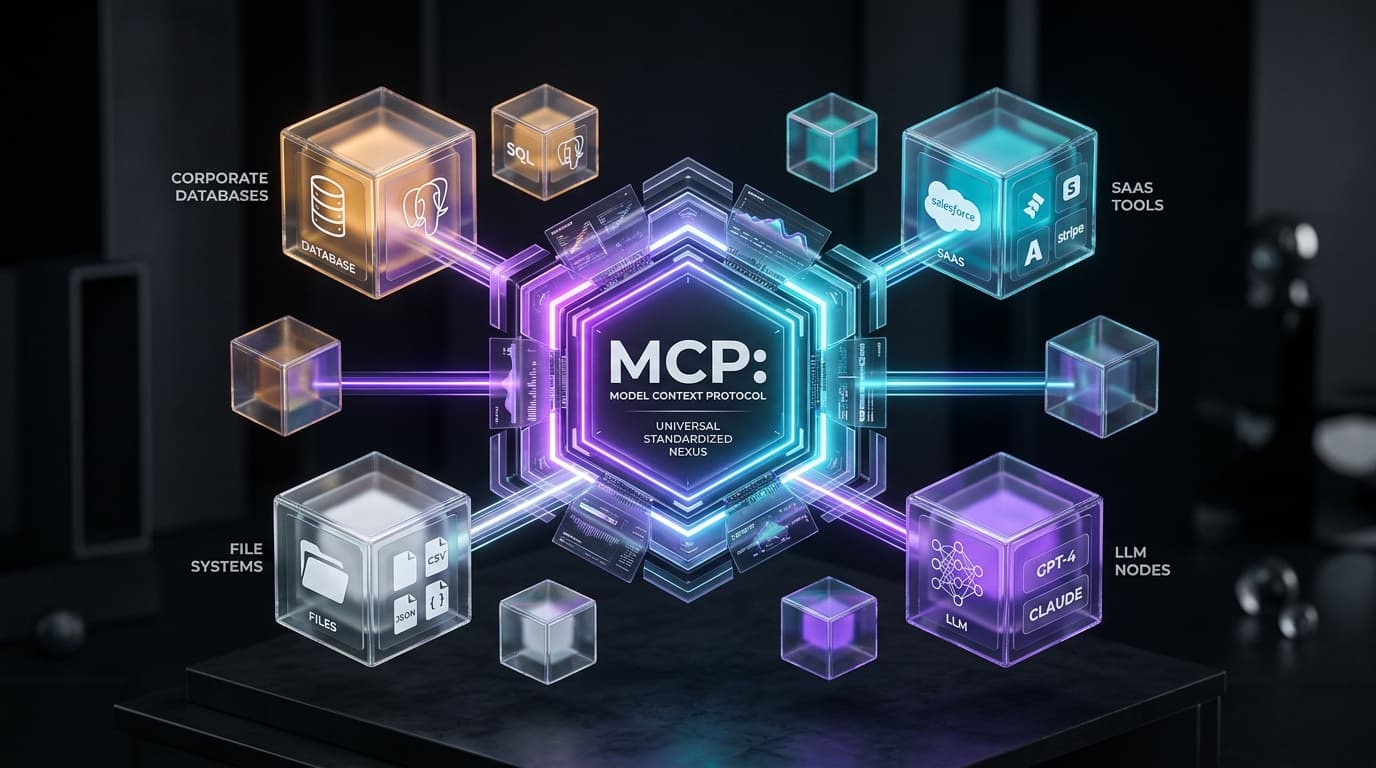
Model Context Protocol (MCP) is an open, standardized protocol that enables AI models to discover, read, and invoke tools and data sources through a universal interface. Build an MCP server for your company once, and any MCP-compliant AI client can instantly interface with your systems safely.
The "USB-C for AI" Metaphor
Just as a USB-C cable lets you plug any laptop into any monitor without a rat's nest of proprietary dongles, MCP allows any AI agent to connect to any data source (GitHub, PostgreSQL, Slack, Salesforce, Google Drive) via one unified standard.
The Problem MCP Solves: The M × N Integration Nightmare
Before MCP, the AI integration landscape was plagued by the classic M × N problem:
- If you had 5 AI agents/providers (OpenAI, Anthropic, Gemini, Cursor, internal custom agents)...
- And 10 enterprise systems (Postgres, HubSpot, Notion, Stripe, Jira, Zendesk, AWS, etc.)...
- Your engineering team had to build and maintain 50 distinct integrations (5 × 10).
With MCP, the equation shifts from multiplication to addition (M + N):
- You build 1 MCP server for each data source (10 servers).
- Each AI agent implements the MCP client specification (5 clients).
- Total integrations: 15. Adding a new AI model or data source requires exactly 1 new connection.
How MCP Architecture Works: Hosts, Clients, and Servers
The MCP specification establishes three core architectural roles:
01
MCP Host
The runtime application where user interactions initiate (e.g., your custom web app, an IDE like Cursor, or an enterprise internal dashboard).
02
MCP Client
Maintains 1:1 connections with servers, negotiates protocol capabilities, and translates LLM requests into structured tool executions.
03
MCP Server
Lightweight microservices exposing specific capabilities: Resources (read-only data), Prompts (reusable workflows), and Tools (callable actions).
5 Tangible Business Benefits of Adopting MCP
Why should forward-thinking founders and CTOs care about MCP in 2026?
- Elimination of Vendor Lock-In: Because your data layers are exposed via open MCP standards rather than proprietary vendor SDKs, you can swap foundation models (e.g. from Claude 3.5 Sonnet to GPT-4o or an open-weights Llama 3 instance) without rewriting your backend tools.
- Drastically Lower Engineering Maintenance: When an API updates, your developers update the single MCP server. Every agent and tool immediately inherits the change.
- Secure Data Boundaries: MCP servers run within your existing VPC or cloud infrastructure. Sensitive customer data never has to be blindly mirrored into third-party vector databases.
- Instant Access to Open-Source Tooling: The global developer community has published thousands of turnkey MCP servers for popular databases, dev tools, and SaaS platforms.
- Future-Proofed Agentic Architecture: As autonomous multi-agent systems mature, MCP serves as the natural inter-agent communication and resource bus.
Security and Enterprise Data Governance in MCP
Giving AI models direct access to enterprise data naturally raises compliance red flags for CISOs. MCP was engineered with enterprise governance at its foundation:
- Explicit Tool Scoping: Clients can selectively expose read-only resources while walling off destructive mutations (DELETE, UPDATE) behind elevated credentials.
- Consent Prompts: Host applications can require user confirmations whenever a high-impact tool (such as sending money or deleting records) is triggered.
- Audit Logging: Every request, payload, and server response can be centrally logged and traced for SOC2, HIPAA, and GDPR compliance audits.
How Your Business Can Prepare for the MCP Era
If your company is planning new AI initiatives or modernizing internal tooling:
- Stop building proprietary bot connectors: Standardize your internal microservices around OpenAPI schemas that can trivially generate MCP server endpoints.
- Audit internal data siloes: Identify key knowledge repositories (customer docs, ticket archives, product specs) that can be exposed as MCP resources.
- Partner with modern engineering studios: At Tech Solo, we design production software architectures with native MCP support, ensuring your digital products stay agile and ready for the next wave of autonomous AI innovation.
Key Takeaway
Model Context Protocol is not just another developer gimmick. It is the architectural foundation that makes enterprise AI practical, scalable, and secure. Businesses that embrace MCP early will spend far less on integration plumbing and far more on shipping real customer value.