If you have ever been trapped in an endless loop with a customer service bot asking you to "choose from options 1 through 5" while your specific problem is option 6, you already understand why traditional chatbots are struggling in 2026.
The conversational interface paradigm has permanently pivoted. Where legacy chatbots relied on rigid decision trees and brittle intent-recognition keywords, modern autonomous AI agents. combine foundation models with real-world tool execution, state memory, and autonomous reasoning. For founders and engineering leaders evaluating tech investments this year, choosing between a chatbot and an AI agent is no longer an academic debate — it directly impacts customer retention, operational headcount, and software scalability.
The Generational Shift: Chatbots to Autonomous Agents
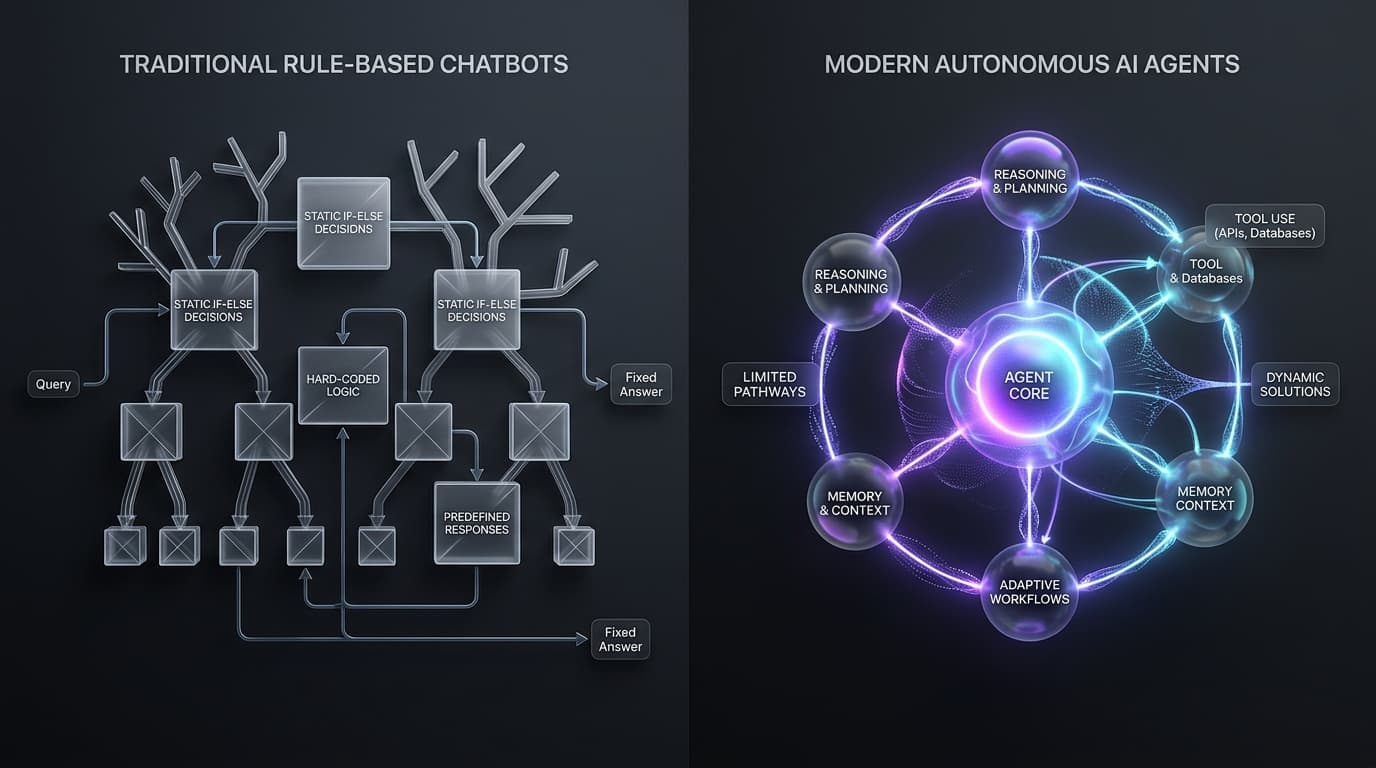
Traditional conversational bots (built on platforms like Dialogflow, Lex, or early Botpress) operate as reactive pattern matchers. They identify an intent from a set of predefined utterances and guide the user through a finite state machine. The moment a customer asks: "Can you cancel my order #4810, reroute the refund to my business card, and notify my account manager?", a traditional bot collapses and prints a generic fallback message.
In contrast, an AI Agent is goal-driven. Given the exact same customer prompt, an autonomous agent:
- Decomposes the objective: Identifies three distinct sub-tasks: order cancellation, payment rerouting, and team notification.
- Authenticates context: Queries your ERP or Stripe API to check whether order #4810 is eligible for cancellation.
- Executes tools: Dispatches a cancellation payload, triggers a webhook to your billing system, and writes an internal note in Slack or HubSpot.
- Communicates outcome: Synthesizes a transparent, empathetic confirmation to the client in natural language.
The Fundamental Paradigm Difference
A chatbot talks about your software; an AI agent operates your software on behalf of the user.
Key Architectural Differences: Static Trees vs ReAct Loops
Understanding what happens under the hood clarifies why AI agents unlock unprecedented business capabilities.
Traditional Chatbots (2018–2023)
- Logic: Static if-else decision trees & intent regex.
- Tool Access: Single-purpose hardcoded webhook integrations.
- Context Window: Stateless or limited to 3-5 immediate turns.
- Adaptability: Requires manual rule configuration for every new edge case.
- Failure Mode: Infinite redirect loops to human operators.
Autonomous AI Agents (2026)
- Logic: Dynamic reasoning loops (ReAct, Plan & Execute, LangGraph).
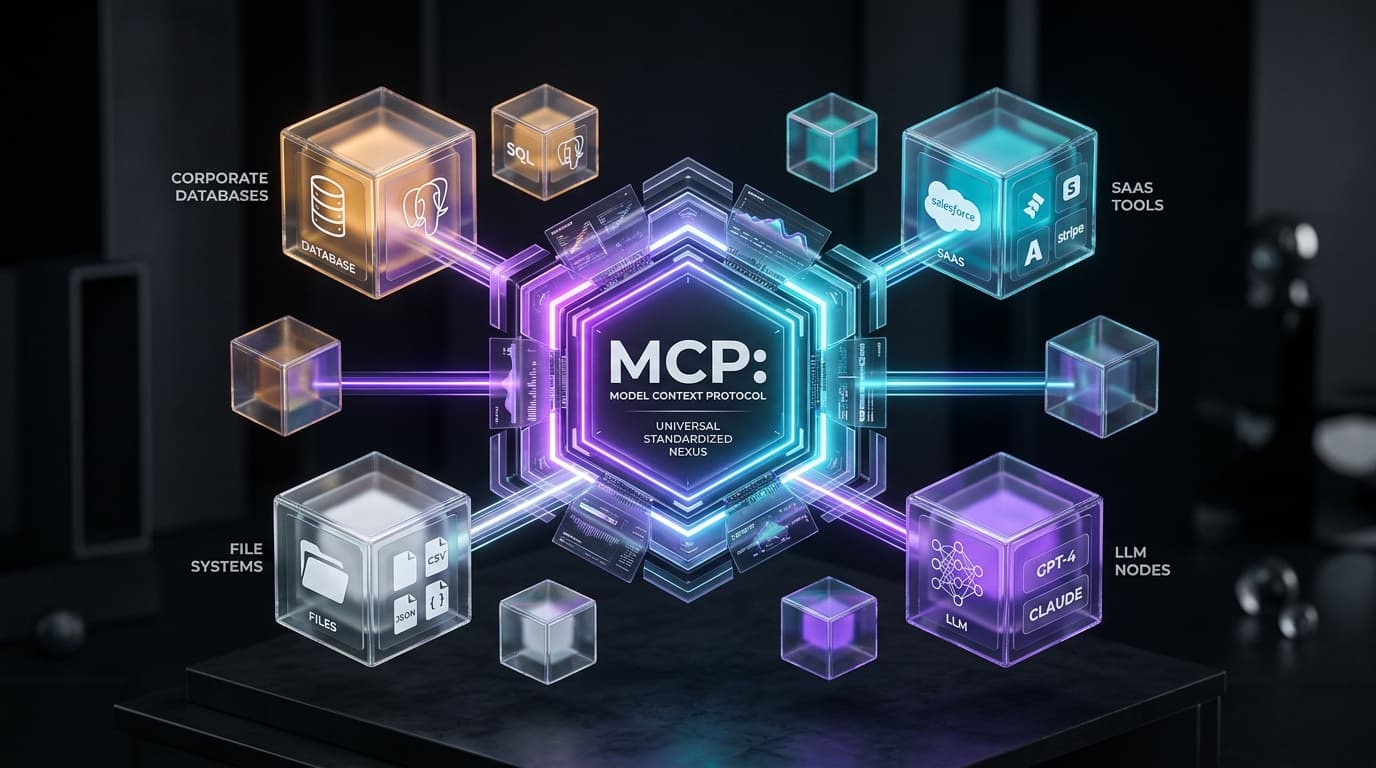
- Tool Access: Model Context Protocol (MCP) and multi-API tool orchestrations.
- Context Window: Massive context buffers (128k–1M+ tokens) with persistent vector memory.
- Adaptability: Self-corrects when tool outputs fail or parameters are missing.
- Failure Mode: Graceful degradation with contextual human-in-the-loop escalation.
Comparison Matrix: Chatbots vs AI Agents in 2026
When making budgeting decisions, compare them across the parameters that directly influence total cost of ownership (TCO) and customer satisfaction:
| Evaluation Factor | Traditional Chatbot | Autonomous AI Agent |
|---|
| Setup Time | 2–4 weeks (manual conversation tree authoring) | 1–3 weeks (tool definition + business guardrails) |
| First-Contact Resolution | 20% – 35% on standard requests | 70% – 85% on complex multi-step workflows |
| Ongoing Maintenance | High (every workflow change requires manual branching) | Low (agent adapts to updated API schemas & documentation) |
| Compute & Token Cost | Negligible ($0.001 per session) | Variable ($0.02 – $0.15 per complex session) |
| System Interoperability | Rigid, bespoke code connectors | Universal via OpenAPI, MCP, and GraphQL protocols |
When to Pick AI Agents vs Scripted Bots
Not every organization needs a multi-agent swarm. Selecting the right tool depends entirely on your risk profile and process complexity:
Stick with Traditional or Hybrid Rule Bots If:
- You only need to answer 15 static, repetitive questions (e.g., store hours, address, return policy links).
- Your industry requires 100% deterministic regulatory scripts where even minimal natural language variance carries legal risk.
- You have zero backend APIs or transactional systems to connect to.
Deploy Autonomous AI Agents If:
- Complex Customer Operations: Your support team handles tier-1 and tier-2 tickets involving order changes, subscription upgrades, billing disputes, and shipping lookups across Shopify, Salesforce, and Zendesk.
- B2B Sales Qualification & Booking: You want an agent that inspects prospect LinkedIn company profiles, evaluates buying signals, queries CRM pipeline data, and schedules custom meetings without human delays.
- Internal Knowledge & Ops Workflows: Your employees spend hours pulling reports across Google Sheets, Jira, and internal databases. An internal agent can execute SQL queries, synthesize trends, and export PDFs in seconds.
Cost Analysis: Token Economics vs Agent ROI
The most common reservation executives raise in 2026 is token cost. While an agentic conversation costs more compute than a static regex bot, looking solely at server bills misses the forest for the trees.
Consider a customer service department receiving 10,000 monthly inquiries. A traditional bot handles 2,500 tickets, leaving 7,500 tickets for human agents at an average industry cost of $8 to $15 per human resolution ($60,000/month).
An enterprise AI agent resolving 7,500 tickets end-to-end with high customer satisfaction might generate $1,200 in LLM token inference fees. By reducing human handling load by 5,000 tickets, the monthly net savings exceed $40,000 — delivering a clean 30x return on technology overhead.
Practical 4-Step Transition Roadmap
To safely transition from legacy bots to agentic infrastructure, Tech Solo recommends this battle-tested phased roll-out:
- Audit High-Frequency API Touchpoints: Map out the 5 most common user actions in your product (e.g., refund, password reset, reschedule, invoice generation).
- Construct Hardened Tool Schemas: Define strict JSON schemas for each API endpoint with boundary checks, preventing prompt injection or parameter tampering.
- Deploy with Human-in-the-Loop Safeguards: Allow the AI agent to draft actions and gather context, but require a human agent one-click confirmation for transactions above a monetary threshold.
- Promote to Autonomous Execution: Once edge-case telemetry demonstrates 99%+ accuracy over 30 days, unlock fully automated agent execution with automated rollback safeguards.
The Bottom Line
In 2026, chatbots answer questions, but AI agents get work done. Businesses that treat conversational interfaces as interactive workflow orchestrators rather than fancy FAQ search engines will maintain an overwhelming speed and efficiency advantage over competitors.