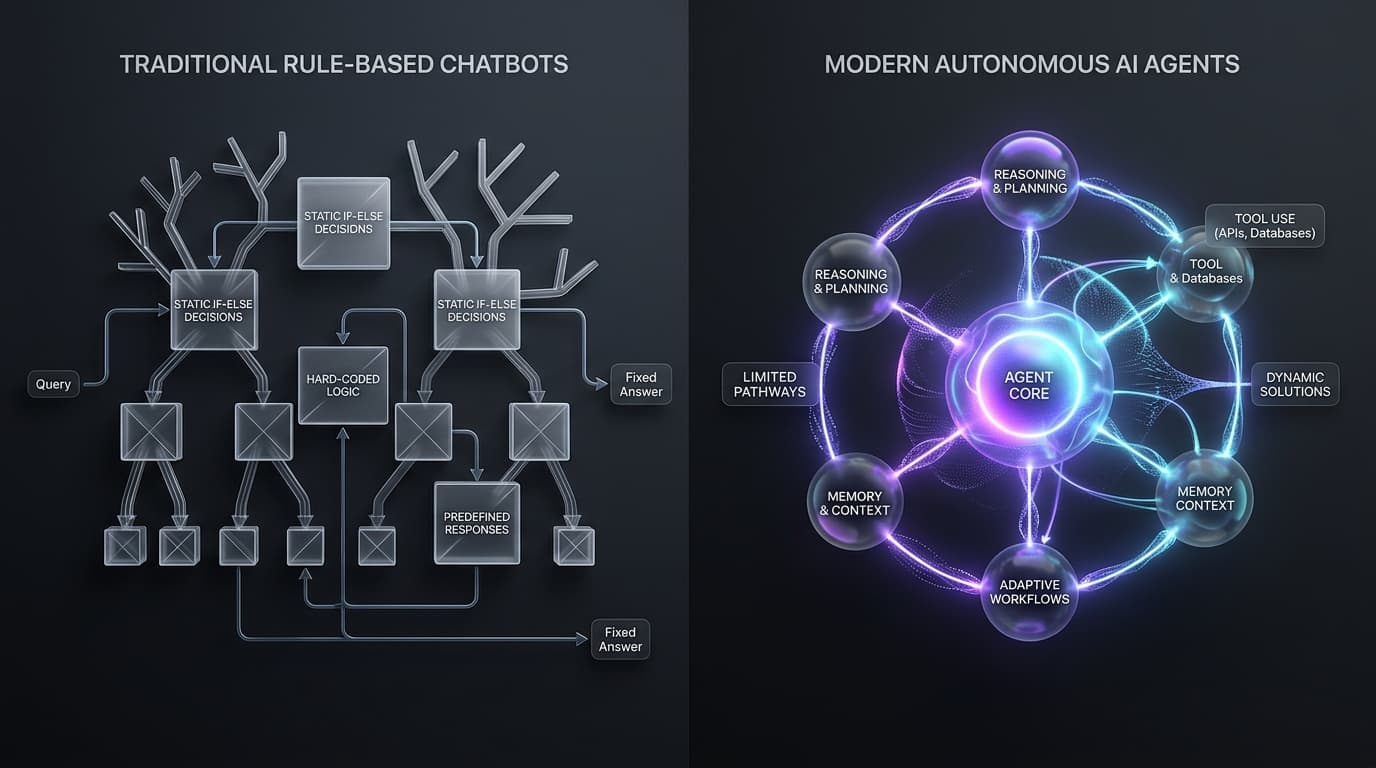
In 2023, launching an "AI product" meant writing a 20-line Express script that forwarded user prompts to the OpenAI completions endpoint. In 2026, the market has zero tolerance for fragile, generic wrappers.
Modern users expect instantaneous responses, buttery-smooth streaming interfaces, rock-solid reliability, hyper-personalized context, and rigorous data privacy. Whether you are building a B2B SaaS platform, an intelligent internal dashboard, or a customer-facing AI workflow tool, professional AI web application development requires deep full-stack engineering expertise.
In this comprehensive engineering guide, we break down the exact architecture, technology choices, and development roadmap Tech Solo utilizes to build high-performance AI web applications in 2026.
Why Simple LLM Wrappers Fail in 2026
If your AI web application does nothing more than prompt a raw foundation model, you face four fatal product vulnerabilities:
- Unacceptable Latency: Waiting 8–15 seconds for a non-streamed LLM generation destroys user retention.
- Runaway Token Expenses: Feeding redundant raw context without semantic caching drains your runway on every user click.
- Hallucinations & Untrustworthy Output: Without anchored retrieval (RAG) and structured output validation, answers cannot be trusted in production.
- Zero Defensibility: Competitors can replicate your entire product prompt in an afternoon. True defensibility lives in your proprietary data loops, workflow integrations, and superior user experience.
The Modern AI Web Application Tech Stack
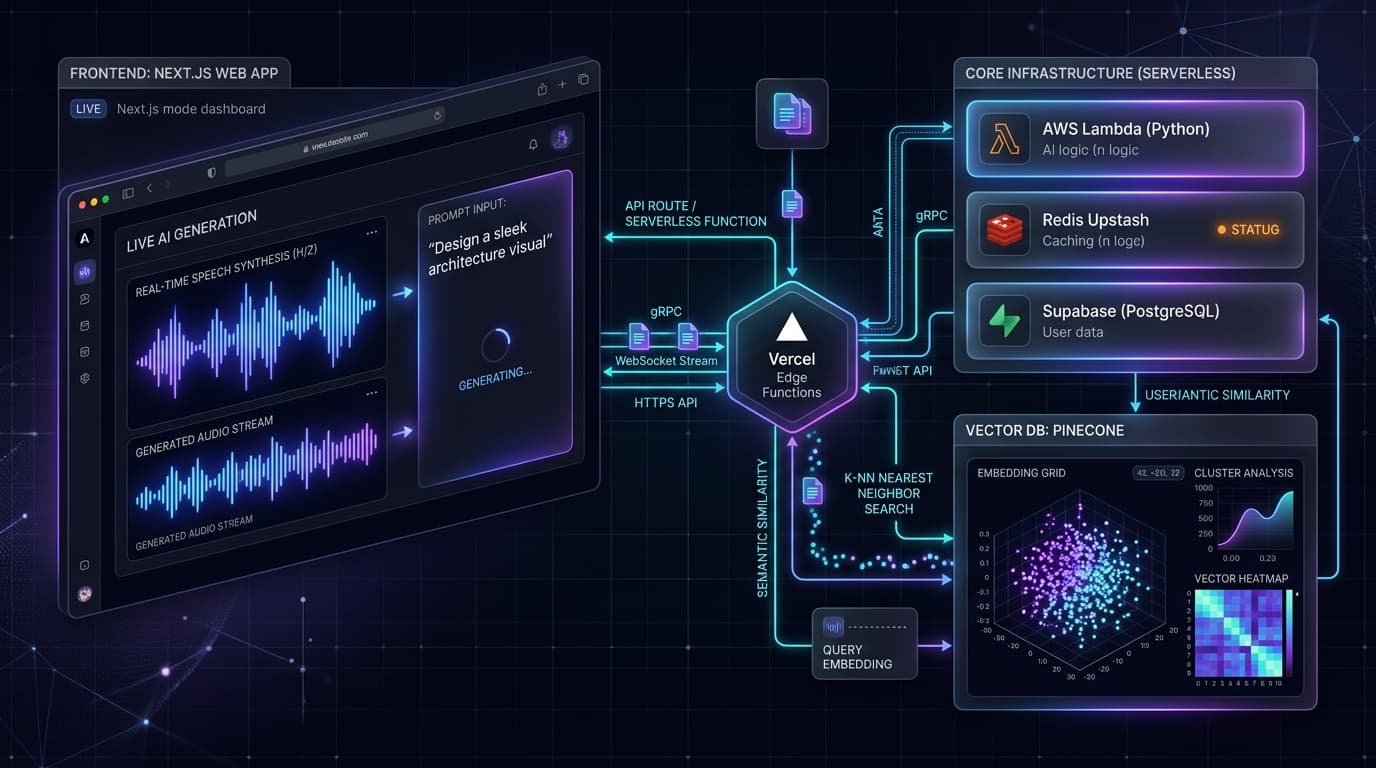
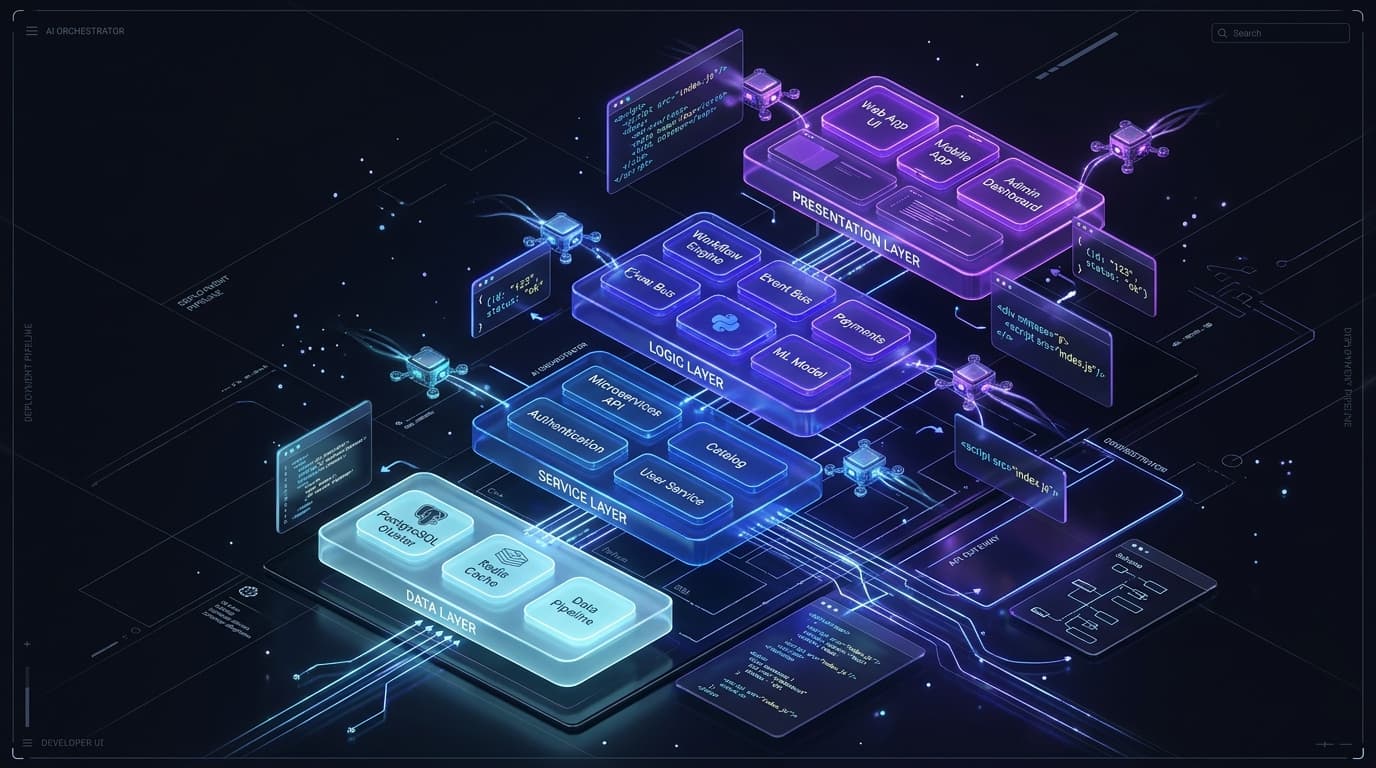
Here is the battle-tested architectural blueprint for scalable AI app development in 2026:
| Layer |
Recommended Technology |
Engineering Rationale |
| Frontend Framework |
Next.js 14+ (App Router) + Tailwind CSS |
Server Components reduce client bundle size; first-class streaming support with Vercel AI SDK. |
| Backend / AI Service |
Python (FastAPI) or Node.js / TypeScript |
FastAPI offers native async support, Pydantic type safety, and seamless integration with HuggingFace / LangChain ecosystems. |
| Database & Vector Storage |
PostgreSQL with pgvector (or Supabase / Neon) |
Unifies relational data and vector embeddings in a single ACID-compliant database, eliminating synchronization drift. |
| Cache & Rate Limiting |
Redis (Upstash / DragonFly) |
Enforces token-bucket rate limits and semantic query caching to slash token bills. |
| Model Providers |
Anthropic Claude 3.5, OpenAI GPT-4o, DeepSeek, Local Llama |
Smart model routing: route quick tasks to fast, low-cost models; reserve reasoning models for complex pipelines. |
UX Patterns: Server-Sent Events (SSE) and Optimistic UI
The golden rule of AI web application development is: never make the user stare at a frozen spinner.
Human perception of speed is dictated by Time to First Token (TTFT). By streaming responses over HTTP chunked transfer encoding (Server-Sent Events), your user sees text rendering within 250 milliseconds:
- Chunked Markdown Rendering: Stream markdown tokens incrementally while preserving syntax highlighting and interactive code blocks.
- Generative UI Components: Rather than returning plain text, instruct models to stream structured JSON objects that your frontend dynamically renders as interactive charts, tables, or buttons.
- Optimistic Updates: Append the user's message to the state array immediately before the network handshake finishes, providing an ultra-crisp messaging experience.
Orchestration & Retrieval: Hybrid Search and Embeddings
Retrieval-Augmented Generation (RAG) is the engine that grounds your AI application in verified corporate facts. However, basic cosine similarity on naive text chunks no longer cuts it.
In 2026, enterprise-grade AI web applications implement Hybrid Search:
- Dense Vector Search: Captures semantic intent and conceptual similarity using modern embedding models (e.g., OpenAI text-embedding-3 or Voyage AI).
- Sparse Keyword Search (BM25): Ensures exact matches for acronyms, serial numbers, product SKUs, and user IDs.
- Cross-Encoder Reranking: Uses a lightweight reranking model (like Cohere Rerank) to evaluate the top 20 candidate chunks and pass only the most relevant 5 snippets into the LLM context window.
Cost & Latency Optimization: Semantic Caching & Routing
Scaling an AI app to 100,000 active users can bankrupt a startup if token consumption is left unchecked. Implement these two high-leverage architectural patterns:
1. Semantic Query Caching
If User A asks: "How do I reset my API key?" and User B asks: "Where can I regenerate my developer token?", both questions share 96% semantic identity. Instead of invoking a $0.03 LLM generation, an in-memory vector cache looks up the previous validated response and returns it in 15ms at zero token cost.
2. Model Cascade & Routing
Not every request requires a flagship frontier model. Use an intent classification router:
- Tier 1 (Triage, classification, formatting): Route to ultra-fast, cheap models (GPT-4o Mini or Claude 3.5 Haiku) at ~$0.20 per million tokens.
- Tier 2 (Deep reasoning, multi-step code generation, analysis): Escalate to flagship models only when necessary.
Production Security: Prompt Injection & Data Isolation
When building an AI application, the prompt itself is an attack vector. Malicious users will attempt to override system rules, extract proprietary instructions, or execute unauthorized database commands.
Defend your application using these critical practices:
- Strict Schema Enforcement: Use OpenAI Structured Outputs or Zod validation so the model literally cannot output arbitrary strings when expecting boolean or enum flags.
- Tenant-Level Data Isolation: Every vector embedding in your database must carry a hard-indexed
organization_id metadata tag, checked at the PostgreSQL Row Level Security (RLS) layer.
- Sandboxed Tool Execution: If the model can run code or trigger webhooks, isolate execution inside short-lived micro-VMs or secure worker containers.
Step-by-Step AI App Development Roadmap
Ready to take your product from concept to launch? Follow Tech Solo's 5-stage engineering blueprint:
01
Discovery & Feasibility
Define the core user problem, evaluate model requirements, and confirm technical feasibility within target latency budgets.
02
Data Architecture & RAG
Structure knowledge sources, establish ingestion pipelines, and configure vector indexing with hybrid search.
03
Interactive UI & Streaming Prototype
Build the Next.js frontend with real-time streaming, optimistic state, and intuitive error fallbacks.
04
Security & Cost Hardening
Implement semantic caching, rate limiting, prompt injection safeguards, and automated regression evaluations.
05
Production Launch & Telemetry
Deploy on high-availability cloud infrastructure with continuous observability (Langfuse, Datadog) to track model drift.
Partner with Tech Solo
Building high-performance AI web applications requires deep full-stack engineering, sensible architecture, and rapid execution. At Tech Solo, we help startups and established businesses design, build, and deploy production-grade AI applications that users love. Have an idea? Let's talk.