In 2023 and 2024, Retrieval-Augmented Generation (RAG) was celebrated as the ultimate cure for LLM hallucinations. By 2026, enterprise software engineering teams have encountered the harsh reality of "Naive RAG": broken semantic links, context fragmentation, and inaccurate answers when users ask multi-dimensional questions.
The solution that has taken enterprise software development by storm is Agentic RAG. By replacing static vector similarity search with proactive agent loops, query decomposition, and hybrid knowledge graph routing, businesses are achieving 95%+ retrieval accuracy on mission-critical corporate data.
Why Traditional (Naive) RAG Collapses at Scale
Traditional RAG operates on an oversimplified assumption: that the top 5 chunks returned by cosine similarity contain the exact information needed to answer the user's question.
In enterprise production environments, this pipeline collapses under real-world conditions:
- Context Window Pollution: Irrelevant paragraphs matching superficial keywords fill the prompt window, distracting the model from key facts.
- Multi-Hop Query Failure: If a user asks: "How did Q3 server infrastructure costs in Europe compare to the budget cap agreed in the May board meeting?", traditional RAG cannot synthesize two documents separated across different time horizons and financial databases.
- No Self-Verification: If retrieved documents are out-of-date or contradictory, standard RAG blindly passes them to the generator without sanity checking.
What Makes Agentic RAG Different: The Planner-Evaluator Loop
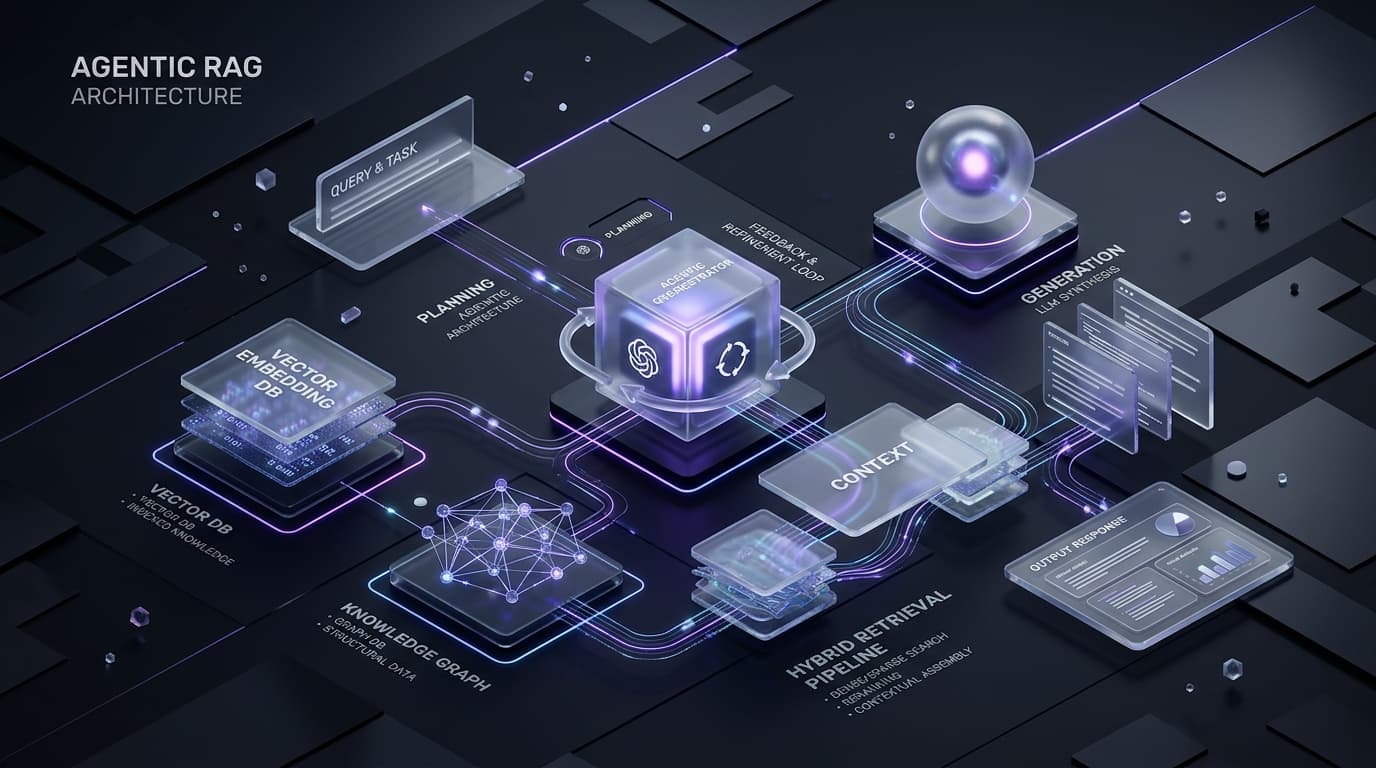
Instead of a one-way conveyor belt, Agentic RAG transforms information retrieval into an active, iterative problem-solving loop.
01 Query Routing
Semantic Planner
Analyzes intent, rewrites ambiguous user prompts, and dispatches sub-queries to appropriate specialized data stores.
02 Retrieval & Rerank
Multi-Source Engine
Queries vector stores, SQL databases, and knowledge graphs simultaneously, running cross-encoder rerankers on the result set.
03 Reflection Loop
Self-Correcting Critic
Inspects the gathered context: Does this fully answer the prompt? If not, triggers an autonomous follow-up query before outputting.
4 Production Architectures: Routing, Self-RAG, Adaptive & GraphRAG
Depending on your data complexity and latency budgets, engineering teams leverage four dominant agentic retrieval patterns:
1. Router RAG
A lightweight classification model inspects the incoming query and dynamically routes it to the optimal storage medium: structured SQL for metric lookups, semantic vector databases for documentation, or live web search for real-time external data.
2. Self-RAG (Self-Reflective RAG)
The model emits special reflection tokens ([Retrieve], [IsRel], [IsSup]) to grade whether retrieval is genuinely necessary and whether the generated answer is strictly supported by source citations.
3. Adaptive RAG
Classifies query complexity: simple factual questions are answered in a zero-hop single retrieval pass (<300ms), while complex analytical queries activate multi-agent tree-of-thought exploration.
4. GraphRAG
Pairs vector embeddings with entity-relationship knowledge graphs (Neo4j, FalkorDB) to map deep organizational hierarchies and dependency chains across millions of unstructured documents.
Combining Vector Embeddings with Knowledge Graphs
Standard Vector Similarity
- Finds text passages with similar conceptual vocabularies.
- Struggles with entity relationships (e.g. "Who reports to whom in Division B?").
- Prone to boundary slicing across arbitrary chunk splits.
Hybrid GraphRAG (2026 Production Standard)
- Traverses nodes and relationships extracted via LLM entity pipelines.
- Combines global thematic summaries with local entity neighborhoods.
- Enables high-precision auditability for enterprise compliance.
Accuracy & Latency Benchmarks: 2026 Enterprise Telemetry
Real-world telemetry across enterprise production deployments reveals the undeniable advantage of agentic architectures:
94.8%
Multi-Hop Factual Accuracy (vs 58% in Naive RAG)
-74%
Reduction in Hallucinated Citations
420ms
Median TTFT with Adaptive Caching
Engineering Blueprint: How to Migrate to Agentic RAG
If your company is experiencing hallucination ceilings with existing RAG pipelines, follow Tech Solo's 4-step migration protocol:
- Implement Cross-Encoder Reranking: Place a dedicated reranker (Cohere Rerank v3 or BGE-Reranker-Large) immediately after your vector retrieval stage to discard low-signal chunks.
- Add Intent Router Middleware: Intercept user queries with a lightweight classification layer before touching vector storage.
- Incorporate Structured Self-Grading: Force the agent to score context completeness before allowing it to generate the final response payload.
- Augment with Entity Graphs: Ingest unstructured PDFs and wikis into an automated entity extraction pipeline to construct a queryable knowledge graph.
Architecting with Tech Solo
Enterprise search in 2026 is no longer about matching keywords—it is about autonomous contextual reasoning. Tech Solo engineers custom Agentic RAG platforms and private enterprise search engines that deliver verifiable, grounded intelligence on your organization's most critical data.