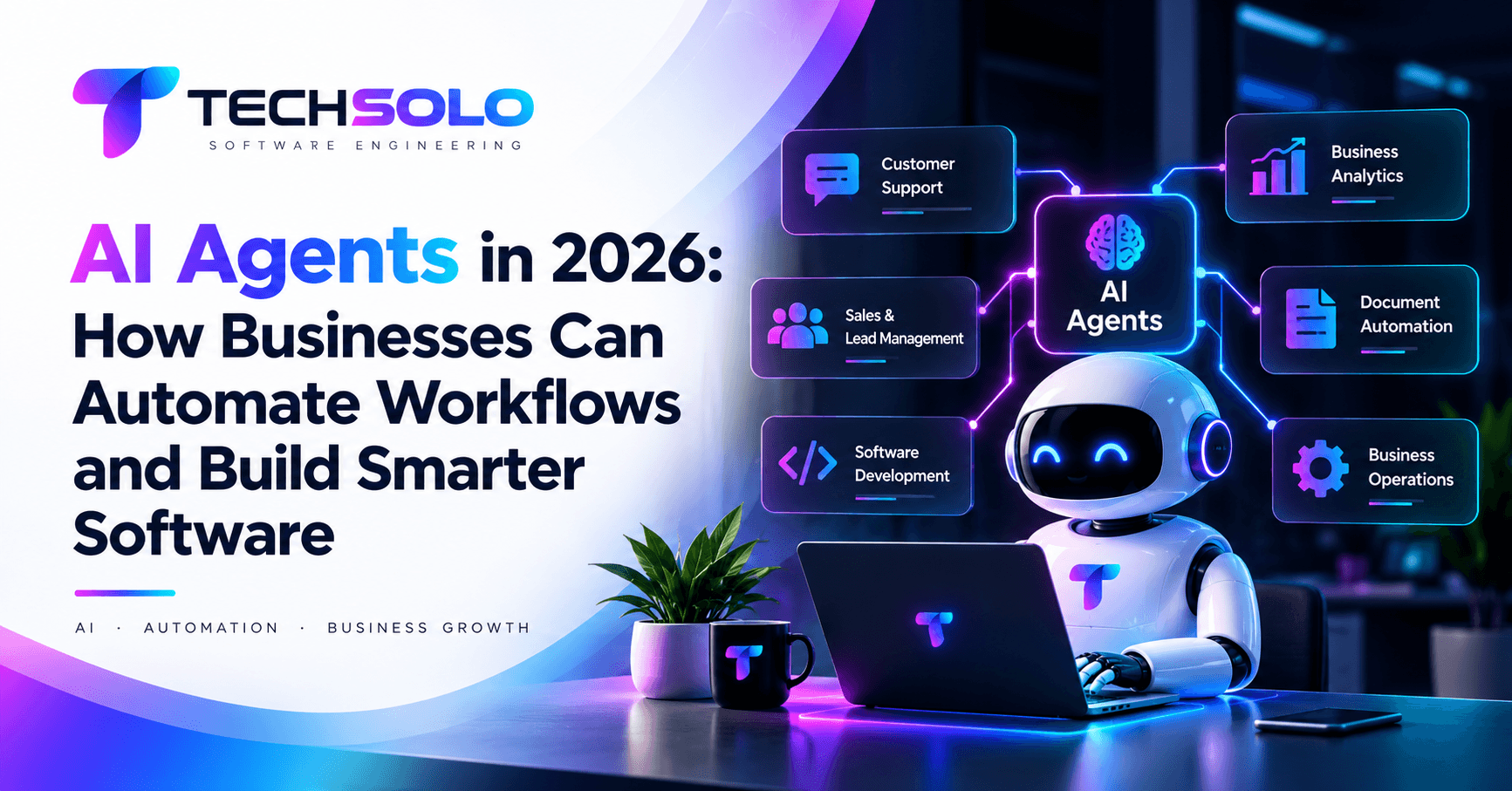
AI Agents in 2026: How Businesses Can Automate Workflows and Build Smarter Software
Artificial intelligence is transforming how businesses operate, develop software, and serve customers. In 2026, businesses are moving beyond basic AI chatbots toward AI agents that can automate tasks, interact with business systems, and support complex workflows.
For startups and growing companies, AI agents offer an opportunity to reduce repetitive work, improve productivity, and build smarter digital products.
What Are AI Agents?
AI agents are software systems that use artificial intelligence to achieve specific goals by interacting with data, APIs, and other software tools.
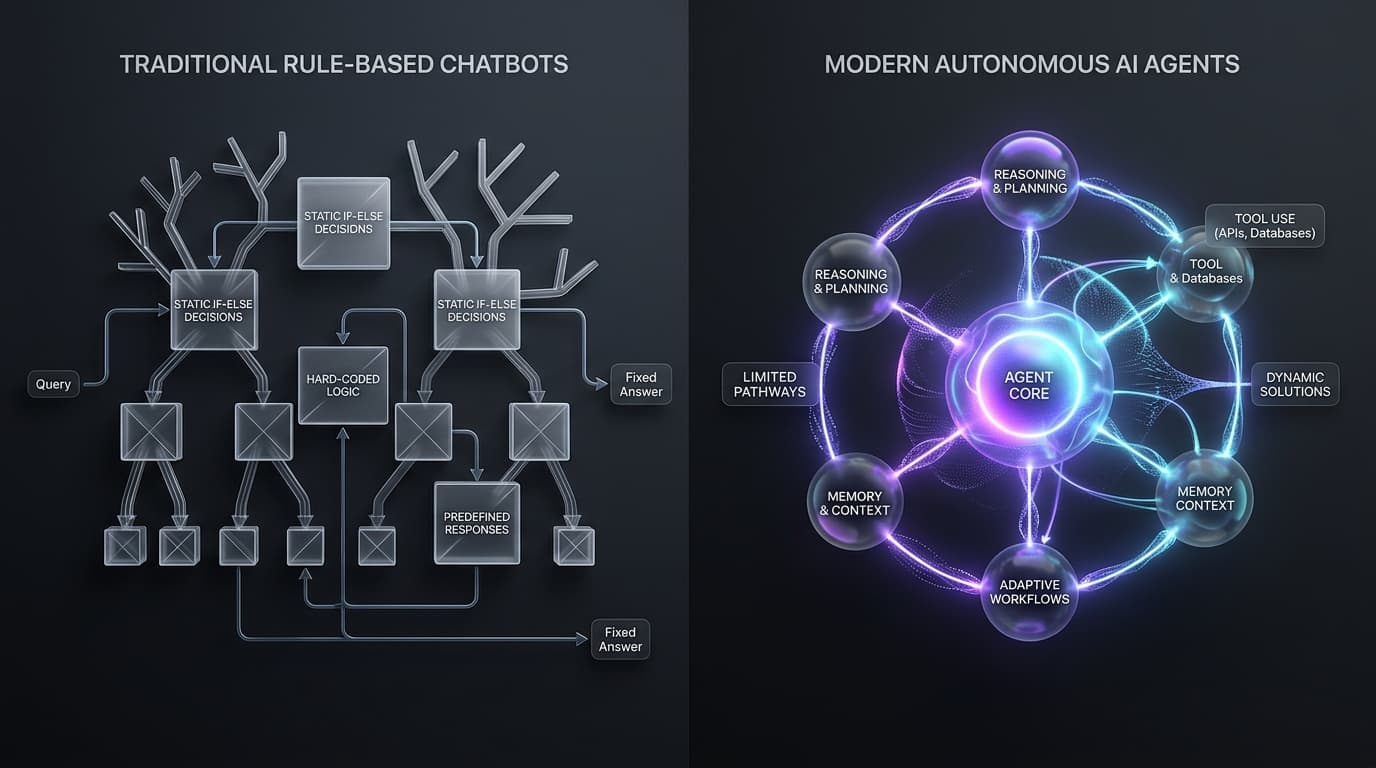
Unlike traditional chatbots that primarily answer questions, AI agents can perform multiple steps in a workflow.
For example, an AI customer support agent can understand a customer query, retrieve order details, prepare a response, and escalate complicated cases to a human representative.
Why AI Agents Matter in 2026
Businesses are increasingly exploring AI to improve operational efficiency and customer experiences.
AI agents can help organizations automate repetitive processes, reduce manual data entry, improve information retrieval, and support faster decision-making.
However, successful implementation requires reliable data, secure integrations, clear business rules, and measurable objectives.
6 Practical AI Agent Use Cases
1. Customer Support Automation
AI agents can answer frequently asked questions, retrieve order information, summarize customer issues, and prepare responses.
E-commerce businesses can integrate AI with their order management systems to help customers check delivery status and understand return policies.
2. Sales and Lead Management
AI-powered workflows can classify incoming enquiries, summarize customer requirements, update CRM records, and prepare personalized follow-up messages.
Sales representatives can review recommendations and focus on meaningful customer interactions instead of repetitive administrative tasks.
3. AI-Powered Software Development
AI coding tools can assist developers with code generation, debugging, documentation, testing, and code review preparation.
Production applications still require experienced engineering, security testing, performance optimization, and ongoing maintenance.
4. Business Process Automation
AI agents can help businesses process invoices, extract information from documents, classify emails, and route tasks to the appropriate departments.
Combining AI with conventional validation rules and human approval helps improve reliability and reduce operational risks.
5. Business Intelligence and Analytics
AI-powered analytics assistants can help authorized employees explore business data, summarize reports, and identify trends.
For example, a retail manager could ask which products have low inventory or which categories performed best during a particular period.
Reliable database queries and verified calculations are essential for accurate results.
6. Industry-Specific AI Solutions
AI agents can support different industries through customized applications.
- Retail: Inventory monitoring and product recommendations.
- Education: Student assistance and administrative automation.
- Healthcare administration: Appointment coordination and document processing.
- Manufacturing: Operational reporting and maintenance documentation.
- Professional services: Document analysis and internal knowledge search.
The right solution depends on each organization's requirements, data, and risk tolerance.
AI Agents vs Traditional Automation
Traditional automation works well when tasks follow predictable rules. AI agents can help when workflows involve unstructured documents, natural language, or contextual interpretation.
For example, traditional automation can process a known invoice format, while AI can help extract information from unfamiliar invoice layouts.
Many businesses benefit from combining both approaches: AI for interpreting information and conventional software for executing validated business rules.
How to Implement AI Agents in Your Business
Step 1: Identify a Business Problem
Choose a repetitive or time-consuming process that could benefit from automation.
Step 2: Prepare Your Data
Ensure that the required information is accurate, accessible, and protected by appropriate permissions.
Step 3: Choose the Right Technology
Depending on your requirements, you may need an AI API, retrieval-augmented generation (RAG), tool calling, workflow automation, or a custom software application.
Step 4: Integrate Existing Systems
Connect the solution to your CRM, database, inventory system, or other business applications using secure APIs.
Step 5: Add Security and Human Oversight
Establish access controls, validation rules, monitoring, and approval processes for sensitive actions.
Track time saved, error rates, operating costs, customer satisfaction, and the number of tasks successfully completed.
Start with a small implementation and expand after the results demonstrate measurable value.
Challenges of AI Agent Implementation
Businesses should consider several challenges before deploying AI agents:
- Data privacy and confidentiality.
- Incorrect or inconsistent AI outputs.
- Integration with legacy applications.
- Model usage and infrastructure costs.
- Security risks and unauthorized tool access.
- Monitoring, maintenance, and accountability.
Careful planning and testing help address these risks and improve the reliability of AI-powered systems.
The Future of AI Agents and Custom Software Development
AI agents are creating new opportunities for businesses to modernize applications and improve existing workflows.
Companies can introduce AI-powered features into new products or integrate intelligent automation into their current software without necessarily replacing their entire technology stack.
The most effective approach is to start with a specific business challenge, implement a controlled solution, measure the results, and expand based on evidence.
Conclusion
AI agents can help businesses improve customer support, streamline operations, assist software development, and make better use of business data.
However, successful AI adoption is not simply about choosing an advanced AI model. It requires the right combination of software engineering, reliable integrations, security, and a clear understanding of business objectives.
At Tech Solo, we believe that effective digital solutions begin with real business needs and the right engineering approach.
Looking to build an AI-powered application or automate your business workflows?
Contact Tech Solo to discuss your next software development project.
Frequently Asked Questions
What is an AI agent?
An AI agent is a software system that uses artificial intelligence and connected tools to perform tasks toward a defined goal.
Can AI agents automate business processes?
Yes. Depending on their design and permissions, AI agents can assist with customer support, document processing, sales workflows, reporting, and other repetitive tasks.
Are AI agents suitable for small businesses?
Yes. Small businesses can start with focused use cases such as customer enquiry classification, document processing, or internal knowledge search.
How much does it cost to develop an AI agent?
Costs depend on the complexity of the workflow, AI model usage, integrations, security requirements, and ongoing maintenance. A small proof of concept is often a sensible starting point.
Do businesses need custom software to use AI agents?
Not always. Existing AI tools may be sufficient for simple tasks, while custom software and API integrations can be useful when a business needs specific workflows, data access, or greater control.